martes, 17 de mayo de 2016

Here’s how Arizona residents are reacting to foreign water mining


First, they depleted their freshwater aquifers.

Now, companies from the Middle East are pumping up limited water supplies in the Arizona desert and exporting it back to Saudi Arabia and elsewhere in the form of hay.

“Camels Don’t Fly, Deserts Don’t Bloom,” a new documentary produced by seven graduate students at Arizona State University, tracks both the business of exporting water from the Southwest desert and the angry reaction of local residents, who are fast seeing their water disappear.

They interviewed me for their 15-minute film that expands on revelations I first reported about Middle Eastern companies mining the limited water in Arizona after similarly depleting aquifers in Saudi Arabia.

The ASU class is a partnership between the Walter Cronkite School of Journalism and Mass Communication and the School of Sustainability. Here is the documentary:

By Nathan Halverson
revealnews.org


viernes, 6 de mayo de 2016

Global water shortages to deliver 'severe hit' to economies, World Bank warns


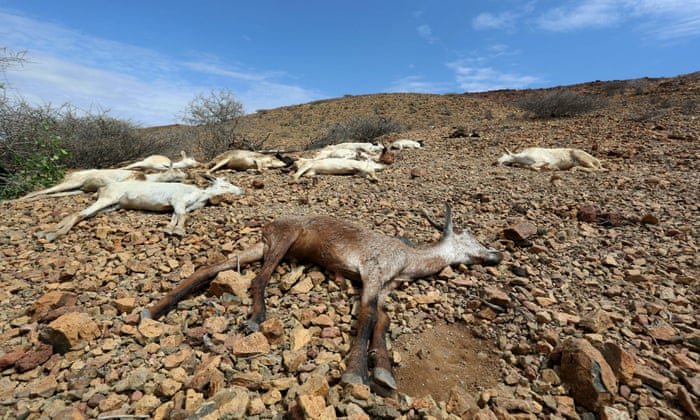
Across the Horn of Africa, millions have been hit by the severe El Niño-related drought. The region is among those projected to take a big hit to GDP by 2050 because of water scarcity. 
Photograph: Feisal Omar/Reuters


Suzanne Goldenberg

The Middle East, north Africa, central Asia and south Asia due to suffer biggest economic hit from water scarcity as climate change takes hold, report finds

Water shortages will deliver a “severe hit” to the economies of the Middle East, central Asia, and Africa by the middle of the century, taking double digits off their GDP, the World Bank warned on Tuesday.

By 2050, growing demand for cities and for agriculture would put water in short supply in regions where it is now plentiful – and worsen shortages across a vast swath of Africa and Asia, spurring conflict and migration, the bank said.

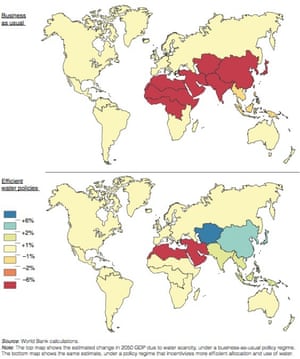
Water shortages could strip off 14% of GDP in the Middle East and nearly 12% of GDP in the Sahel – without a radical shift in management, according to the bank’s projections.

Central Asia could lose close to 11% of GDP and east Asia about 7% under business-as-usual water management policies, according to a new report.

Taking into account all regions, the mid-range toll of water shortages on GDP was about 6%.

“There is a severe hit on GDP,” said Richard Damania, lead environmental economist for the Bank and author of High and Dry: Climate Change, Water and the Economy.

World scarcity impact on GDP – World Bank map released on 3 May 2016

Global water scarcity impact on GDP. Photograph: World Bank

Governments have grown increasingly concerned about the threat to water supply because of a combination of climate change and increasing demand

Barack Obama invited business leaders to the White House last March for a business summit aimed at protecting California from the next drought – by mobilising investment in data and other technologies that would promote more efficient use of water.

The biggest economic hit due to water deficits were expected to occur in the Middle East, north Africa, central Asia, and parts of south Asia, the report found.

There would be virtually no impact on the economies of North America and western Europe.

Much of the world faces a hotter and drier future under climate change, according to scientists.

Rainfall – including the monsoons that fortify agriculture in south Asia – will become more unpredictable. Storm surges could contaminate freshwater reservoirs.

But there will also be pressure on water supply from rising populations – especially in cities – and increased demand from agriculture.

“It turns out that economic growth is a thirsty business,” Damania said.

Some cities could see water availability drop by two-thirds by 2050, the report found.

Water shortages could have rebounding effects on food production, public health, and household incomes – with families forced to pay more for a basic necessity.

But, the report said, encouraging more efficient use of water could make a big difference in the mid-century economic scenarios for regions threatened by water shortages.

In some countries, about two-thirds of water is lost to old and leaky pipes.

Good water management policies would add more than 11% to the GDP of central Asian countries and blunt the impact of water shortages in the Middle East, the report found.

theguardian.com

sábado, 4 de julio de 2015

Singularity University Impact Challenge


Be Part of California's Drought and Water Solutions
 
Currently, California suffers from an annual water deficit in excess of 6 million acre-feet, unsustainably drawn from the state’s two primary water resources–groundwater and surface waters. This water deficit is higher during a drought, and California is in the fourth year of one of the state's worst droughts in the past century that has led to fierce wildfires, water shortages and restrictions, and staggering agricultural losses. While the water problem in California is not new, there are multiple efforts across the state to reduce water consumption to counter balance the shortfall. California Governor Jerry Brown issued an executive order in April 2015 that cities throughout the state reduce water usage by 25 percent, a groundbreaking mandate from the Governor's office to limit water use for the first time ever.

Traditional water supply and demand solutions have overall failed to solve California’s water problems. We have an unprecedented opportunity–and the focus of this challenge–to generate 21st century water solutions today that promise innovative, resilient supplies for tomorrow.

It is important to take into consideration that water issues are not limited to California, but a growing concern across the United States. As drought, flooding and climate change restrict America's water supply, demands from population growth and energy production are expected to increase.  While other U.S. States have not been ordered to reduce water use, 40 out of 50 states have at least one region that is expected to face some kind of water shortage in the next 10 years.  Water supply solutions in California can be a catalyst to address water issues throughout the United States and other parts of the world.

Three Winning Teams

Three winning teams will be chosen. These teams will have developed novel solutions using exponential technologies that are able to achieve the greatest gain (in total acre-feet) in new forms of water supplies, capture or reuse for any agricultural, industrial, commercial or residential application within the state of California (but can be equally applicable beyond California).

Judging Criteria

All applications will be judged according to the following criteria:

Use of Exponential Technology
Technical Feasibility & Rigor
Innovative Solution
Market Viability
Scalability
Design & Utility Function

Preference will be given to applicants that demonstrate proof of concept in the form of a prototype to validate their ideas or solutions.

A panel of judges, comprised of SU faculty, local and state government representatives, and Impact Partners will determine the 3 winning teams and the 3 runners up. The judges will evaluate all entries and assess compliance with the judging criteria.

The Prize

The prize for 3 winning teams is a place in the Entrepreneurs in Residence program at the SU Startup Lab on our campus at NASA Research Park in Silicon Valley. http://startup.singularityu.org/

Each winning team receives US$5,000, space at the SU Startup Lab, mentoring and access to the SU Startup Lab network and the Silicon Valley innovation ecosystem.

In addition, the top 3 runners up receive the opportunity to pitch their ideas/solutions at the SU Startup Lab to the SU community.

All winning teams and runners up receive recognition in the Singularity University newsletter, Impact Challenge webpage and through social media efforts.

Competition Schedule

Competition Opens: June 15, 2015
Competition Closes: September 15, 2015
8 - 10 Finalists Announced: Mid-September (The finalists will be invited to pitch their solutions to a panel of judges at a public Pitch Event.)
Winners Announced: At a Pitch Event, End of September/Early October 2015 at Singularity University (The panel will select 3 winning teams that will be invited to become Entrepreneurs in Residence at SU Startup Lab. The 3 runners up will be invited to spend a day at the SU Startup Lab to to pitch their solutions to the SU community.)
Start date for 3 Winning Teams to become Entrepreneurs in Residence at SU Startup Lab: Between October and December 1, 2015.  Other start dates can be discussed.

Application Requirements

CV/Resume

Summary of accomplishments

Abstract of idea or prototype. Include anticipated timeframe needed as an Entrepreneur in Residence at SU Startup Lab, possible start date, and what would be accomplished during that timeframe. There is a preference that the state date be no later than December 1, 2015.

Video of idea or prototype (must provide the URL/webpage to video -- DO NOT send the video)

Competition Rules

The competition is open to international applicants.

Teams are welcome to submit an application and can submit more than one solution. A team is 2+ members. Submissions from individuals will be considered but preference will be given to submissions from teams.

Applicant must indicate compliance of Terms and Conditions by click through acceptance before applying.

Instructions for Applying

Step 1) Sign in at the top of the page.

Step 2) Once you complete the sign in process, you will get an email to confirm your registration. Check your spam box just in case! Please add us to your safe sender list so that you can continue to receive messages from us.

Step 3) Upload all application material on the site as per the instructions you will see upon log in.

Advisory Committee

An advisory committee comprised of SU faculty, local and global experts and partners will advise on the design and execution as well as provide oversight of the 2015 SU Impact Challenge.

Contact Information

If you have any questions about the application process, contact us at: impact@singularityu.org (With subject line: SU Impact Challenge 2015)


sábado, 22 de marzo de 2014

World Water Day 2014 - videos


World Water Day 22 March - UN

World Water Day 2014
On World Water Day, let us pledge to develop the policies needed to ensure that sustainable water and energy are secured for the many and not just the few".
Secretary-General Ban Ki-moon
Message for the World Water Day

2014 Theme:
Water and Energy

Water and energy are closely interlinked and interdependent. Energy generation and transmission requires utilization of water resources, particularly for hydroelectric, nuclear, and thermal energy sources.
Conversely, about 8% of the global energy generation is used for pumping, treating and transporting water to various consumers.
In 2014, the UN is bringing its attention to the water-energy nexus, particularly addressing inequities, especially for the 'bottom billion' who live in slums and impoverished rural areas and survive without access to safe drinking water, adequate sanitation, sufficient food and energy services.
It also aims to facilitate the development of policies and crosscutting frameworks that bridge ministries and sectors, leading the way to energy security and sustainable water use in a green economy. Particular attention will be paid to identifying best practices that can make a water- and energy-efficient 'Green Industry' a reality.

Join us in this celebration and spread these messages:

1. Water requires energy and energy requires water.

Water is required to produce nearly all forms of energy. Energy is needed at all stages of water extraction, treatment and distribution.

2. Supplies are limited and demand is increasing.

Demand for freshwater and energy will continue to increase significantly over the coming decades. This increase will present big challenges and strain resources in nearly all regions, especially in developing and emerging economies.

3. Saving energy is saving water. Saving water is saving energy.

Choices concerning the supply, distribution, price, and use of water and energy impact one another.

4. The “bottom billion” urgently needs access to both water and sanitation services, and electricity.

Worldwide, 1.3 billion people cannot access electricity, 768 million people lack access to improved water sources and 2.5 billion people have no improved sanitation. Water and energy have crucial impacts on poverty alleviation.

5. Improving water and energy efficiency is imperative as are coordinated, coherent and concerted policies.

Better understanding between the two sectors of the connections and effects on each other will improve coordination in energy and water planning, leading to reducing inefficiencies. 
Policy-makers, planners and practitioners can take steps to overcome the barriers that exist between their respective domains. Innovative and pragmatic national policies can lead to more efficient and cost effective provision of water and energy services.

miércoles, 29 de enero de 2014

viernes, 6 de diciembre de 2013

Ancient Water Irrigates Saharan Oasis

La agricultura de oasis sahariano
Image: European Space Agency
By Rachel Feltman
Outside Al Jawf, Libya, a verdant oasis blooms in the middle of a desert. 
Farmers irrigate their Saharan fields, which receive only 2.5 millimeters of rain a year, with so-called fossil water from a massive aquifer beneath a large swath of northeastern Africa. 
The Nubian Sandstone Aquifer System is a remnant of wetter eras going back 20,000 years, when heavy rains fell that ultimately penetrated more than three kilometers into the earth.
Why are the agricultural plots perfectly round? The oasis relies on center-pivot irrigation, in which a single, rotating beam of sprinklers delivers water to crops planted around a central point. 
The size of the plots—up to one kilometer in diameter—helps them stand out in this image from Japan's Advanced Land Observing Satellite.
scientificamerican.com


This article was originally published with the title What is It?.